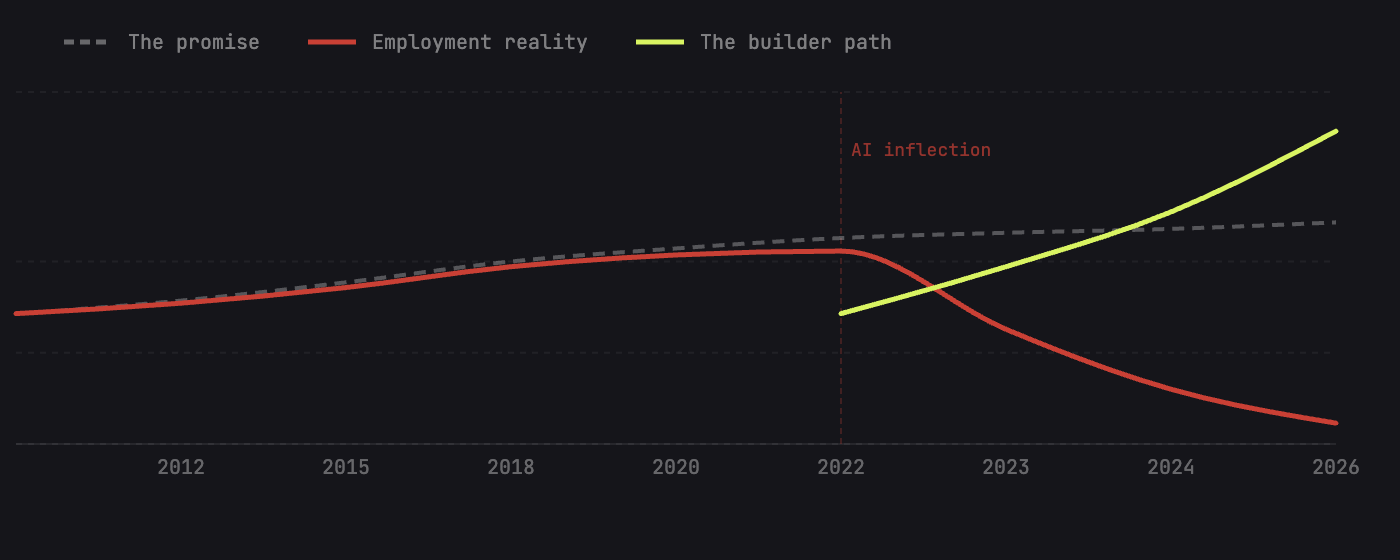
There is a story that India's tech industry has been telling itself for about thirty years. It goes something like this: study hard, get into a good college, land a job at a services company or a product firm, work your way up, and you will be fine. The story was never completely true — it glossed over the anxiety of appraisal cycles and the randomness of promotions and the way entire teams got "restructured" when a client changed their mind. But as a general promise about what a career in tech would look like, it held.
It is no longer holding. And the speed at which it is unraveling is something most people are only beginning to process.
In the first five months of 2026, over one lakh jobs were cut in the technology sector globally, with India absorbing a significant share of that pain. May alone saw nearly 29,000 layoffs. March was worse — 46,000 in a single month.[1] These numbers come not from some distant Silicon Valley reckoning but from companies with large India footprints: Infosys doing what it calls "skills realignment," TCS quietly shedding 12,000 people,[2] GCCs trimming headcount at a pace that would have been unthinkable three years ago.
What makes this different from earlier waves of tech disruption is the nature of what is being replaced. The dot-com bust in 2000 killed speculative companies. The 2008 slowdown hit hiring but left the structural logic of IT services largely intact. What is happening now is different. AI is not disrupting a business model. It is making a category of cognitive work — the kind that India's tech workforce was specifically trained to do — dramatically cheaper to perform.
Writing code, reviewing documents, handling customer queries, processing applications. These are not the glamorous tasks of a senior architect. They are the bread-and-butter work of the two to eight year experience band. The people who are not yet senior enough to be irreplaceable, but not junior enough to be cheap. The exact band where most of India's six million tech workers sit.
"Corporate ladders are gone," Saurabh Mukherjea said in May 2025.[4] He was not making a provocative claim. He was describing something that most people in their thirties had already begun to feel but had not yet found words for.
The numbers are not the hardest part
The hardest part is not the layoffs themselves. People lose jobs. That has always happened. The hardest part is that the mental model most Indian tech workers built their careers on — the idea that continuous employment was the natural, expected outcome of staying skilled and working hard — is losing its explanatory power. When your peer with ten years of Java experience gets let go, not because he did anything wrong, but because a model now drafts the boilerplate he used to write, the old narrative stops making sense.
An IIM-Ahmedabad study found that 68% of white-collar workers fear their roles could be automated within five years.[3] A LinkedIn survey in early 2026 found that 84% of Indian professionals feel unprepared to find a new job.[5] These are not the numbers of an industry in transition. These are the numbers of an industry in crisis — a quiet one, conducted mostly through declined renewal letters and performance-improvement plans and one-sided "restructuring conversations."
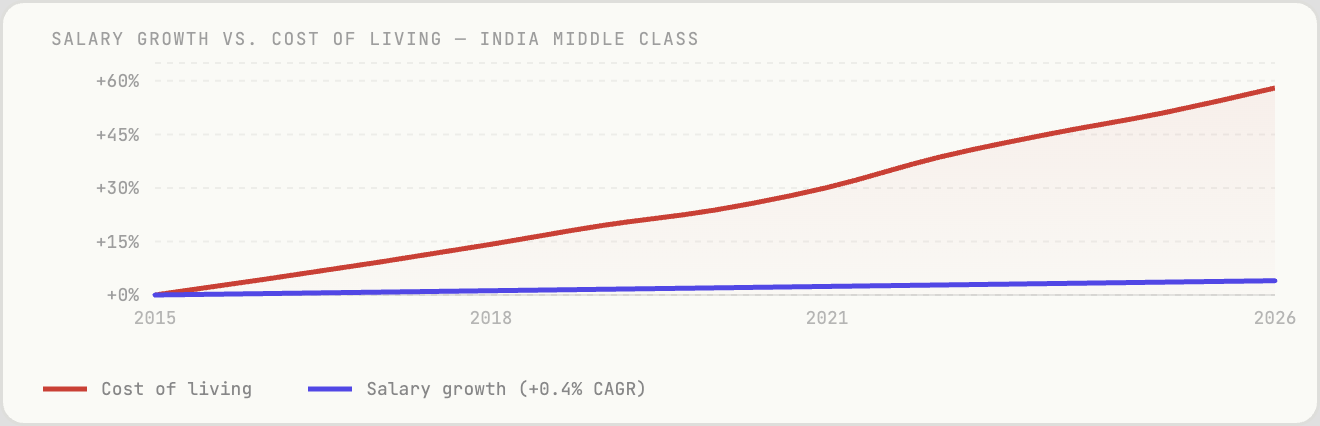
Meanwhile, the salary math that was supposed to compensate for all this has quietly stopped working. Adjusted for inflation, salary growth for India's middle class has been 0.4% per year over the last decade.[6] Not zero. Not negative. Just: nothing. The kind of growth that sounds fine until you realise that your EMI and your children's school fees and your rent have not grown at 0.4%.
The thing nobody says out loud
Nobody in a company town announces that the contract is changing. There is no press release. What you get instead is a slow accumulation of signals that individually seem unremarkable. Hiring freezes described as "being more deliberate." Attrition celebrated as "natural rightsizing." Performance improvement plans that are really just documented paths to the exit. A new generation of managers who have learned to say "restructuring" with exactly the same calm they would use to say "good morning."
The people living through this are processing it differently depending on where they are in their careers. Engineers with twenty years of experience have usually accumulated enough seniority that the immediate risk feels distant. Fresh graduates are discovering that the volume of entry-level roles has thinned considerably since 2022. And the people in the middle — five, six, eight years in, often with EMIs and families and the life they were told their career would support — are experiencing something that does not yet have a common name.
It is not quite fear. It is more like a slow revision of what they thought was a stable assumption. Like finding out that the ground under a building is not as solid as the builder said.
But something else is also true
This is not the first time a technological shift displaced a category of work. And in every previous case, the disruption that took things away also made new things possible that had not existed before. What is different this time, specifically for India, is the combination of forces that now exist simultaneously.
UPI processes 22 billion transactions a month.[7] India's freelance platform market crossed $265 million in 2025, growing at 25% a year.[8] The infrastructure to earn money independently — to invoice a client, to receive payment, to operate a small business — exists in a way it simply did not a decade ago. At the same time, the cost of building software products has collapsed. What required a team of fifteen people in 2018 can now be built by one person with a laptop and a good sense of what problem they are solving.
Solo developers in India are quietly building products that generate five to fifteen lakh rupees in monthly recurring revenue — not through venture capital, not through large teams, but through finding a specific problem that a specific group of people have and solving it well enough that those people pay for it every month.
None of this cancels out the anxiety. The anxiety is real and rational. But it sits alongside an opportunity that is also real, and also unprecedented.
The question is not whether the contract is changing. It is. The question is what you do with the fact that the old answer no longer works. And that is a question that, surprisingly, very few people are helping anyone think through.
What this actually requires
The shift from employee to founder is not mainly a skills problem. Most of the people who are well-positioned to build something — who have years of technical depth, who understand how software gets built, who have seen businesses operate from the inside — do not lack the raw material. What they often lack is the way of thinking that makes use of that material.
There is a specific kind of judgment that the employment system actively discourages. The habit of asking whether anyone would actually pay for this before building it. The willingness to treat your own assumptions as the thing most likely to be wrong. The ability to sit with ambiguity long enough to find the real problem instead of the obvious one. The impulse to take a small, falsifiable step rather than waiting for a complete plan.
These are not exotic traits. They are trainable. But they require deliberate practice, and they are almost completely absent from the education and career environments that most Indian tech workers have spent the last decade inside.
The contract is breaking. That part is not in your control. What is in your control — imperfectly, with real risk, with no guarantees — is whether you use the disruption as a reason to stay still and hope, or as a reason to start developing the kind of judgment that the next chapter will actually reward.
That is what Senfra is for. We are not a course. We are not an accelerator with a selection committee. We are an attempt to give India's six million tech workers a serious, structured path to answer the question that the old contract never taught them to ask: what can I actually build? And how?
Start with the mindset. The rest follows.
Work through a curriculum designed around the specific judgment shifts that employee-to-founder transitions require. You earn a Builder Score. If you clear the gate, the whole platform opens. If not, you get a development path and a retry window. Either way, you leave knowing something real about how you think.
Join the waitlist →Early access. No spam. Just a note when we open.
References
- Layoffs.fyi tracker, reported by The Hans India — Tech layoffs cross 1 lakh in 2026 so far, nearly 29,000 jobs lost in May (June 2026)
- People Matters / Gulf News — TCS confirms 12,000 layoffs in strategic workforce realignment; Yahoo Finance: TCS to cut workforce by 2%
- NASSCOM Insights / IIM-Ahmedabad & Wadhwani Foundation study — 68% of Indian IT Professionals Fear AI Replacement; peer-reviewed analysis: Psychological impacts of AI-induced job displacement among Indian IT professionals (PMC)
- BusinessToday — 'Corporate ladders are gone': Saurabh Mukherjea warns India's middle class must pivot or perish (May 2025)
- LinkedIn India — 84% of professionals in India feel unprepared to find a job in 2026, via Deccan Chronicle (2026)
- BusinessToday / CMIE data — 9% hike looks high vs US, UK, but inflation eats gains: India middle class sees no real rise (March 2026)
- NPCI monthly data, reported by News on Air — UPI transaction volume rises 29% YoY to 21.63 billion in December (January 2026)
- Grand View Research — India Freelance Platforms Market Size & Outlook, 2026–2033; India market: USD 265.1 million in 2025, CAGR 25.1%