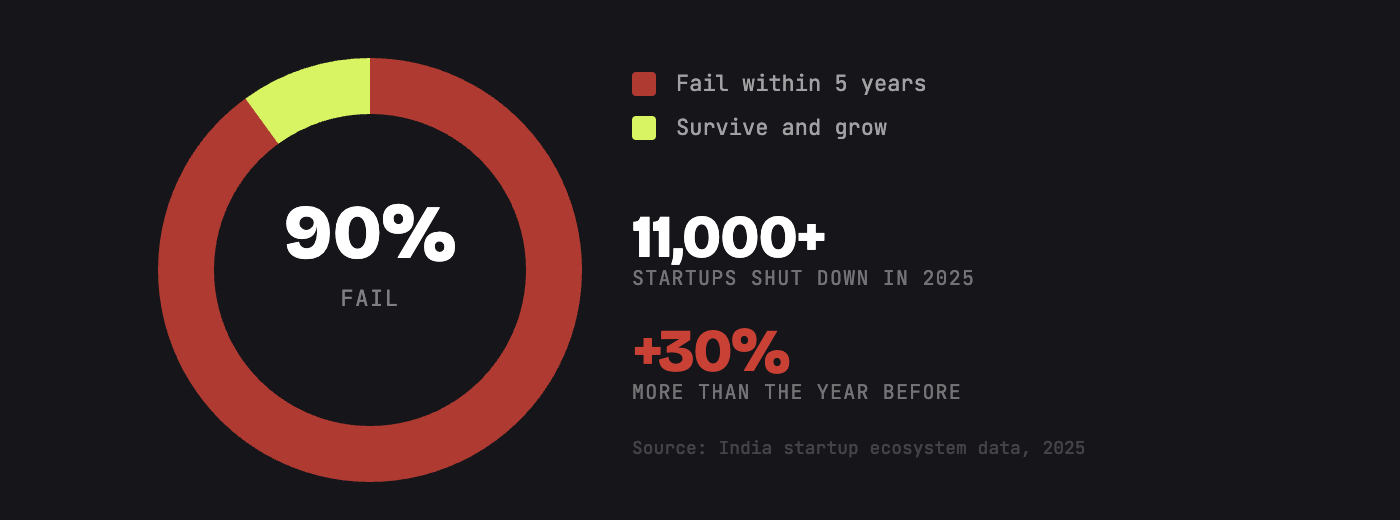
Ninety percent of Indian startups fail within five years.[1] You have probably seen this statistic before. It circulates at startup events, shows up in every founder advice article, and is occasionally wielded by parents trying to talk their children out of leaving stable jobs. What is almost never discussed is what the statistic actually means — not as a cautionary tale, but as a diagnostic. Why, specifically, are they failing? And what did the ten percent do differently?
In 2025, over 11,000 Indian startups shut down. That is a 30% increase from the year before, and the numbers for 2026 are tracking higher still.[2] The edtech sector alone saw a 60% failure rate as the pandemic-era demand that had inflated the whole category evaporated and no one had built businesses underneath the bubble. Fintech saw 75% failure among venture-backed companies, mostly from a combination of regulatory tightening and business models that had been designed around growth at any cost rather than around customers who actually needed the product.[3]
But focusing on sectors misses the deeper pattern. Across all of these failures, the causes cluster into a small number of recurring mistakes. And almost none of them are the ones that founders worried about before starting.
The thing that kills most of them
Between 36% and 42% of Indian startup failures trace back to a single root cause: building something nobody wanted.[4] Not building it badly. Not pricing it wrong. Not failing to market it. Building a thing that solved a problem the founders imagined, rather than a problem customers actually had and were already trying to solve.
This is the product-market fit problem, and it is so well-documented that it has become almost background noise in startup conversation. People know the term. They use it in pitch decks. They say "we're working on PMF" the way they might say "we're working on our metrics" — as a phrase that signals awareness without necessarily indicating action. What most people do not do is actually test whether they have it before they spend significant time and money assuming they do.
The founders who failed did not lack intelligence or work ethic. What they lacked was the discipline to be wrong early, cheaply, and on purpose — before the market made them wrong expensively and by accident.
The specific Indian version of this problem has a texture to it. India is a market where almost every problem-space looks larger than it is from a distance, because the population numbers are so enormous that even a tiny percentage of a category is a large absolute number. A founder building something for small business owners in India can truthfully say their total addressable market is 63 million MSMEs.[5] What they cannot always truthfully say is that any specific MSME, in any specific city, with any specific problem, would pay for what they are building. The gap between the TAM and the first customer is where most startups quietly lose their nerve and their runway.
What the survivors did instead: They sought out the specific person who had the specific problem — not to pitch them, but to understand what they were already doing about it. If the person said they had no problem, or that what they were already using was fine, that was a finding. If they said "actually I spend four hours every week on exactly this and I hate it," that was a different kind of finding. The discipline was in going to the person first, not to the idea.
What is not happening, in many cases, is learning. The building is happening in the absence of real customers, real feedback, and real attempts to sell the thing. By the time the product is "ready," the founders have a detailed understanding of what they built and almost no understanding of whether anyone wants it. Then they launch, and the silence is confused with a marketing problem, when it is almost always a much earlier problem that had been accumulating for months.
What the survivors did instead: They sold before they built — or at least tried to. They showed prototypes, mockups, or just described the thing and asked for commitments. The people who pre-paid were real signal. The people who said "sounds great, let me know when it's live" were not.
Astrotalk crossed ₹1,200 crore in FY25[6] selling something many educated people consider irrational, because the value is immediate and emotionally legible. Zerodha built a category-defining business because "this helps you make and protect money" is a concrete outcome. Tally has been collecting recurring subscription revenue from Indian SMBs for three decades because tax compliance is non-negotiable.
What the survivors did instead: They framed value in terms of outcomes that were concrete, quantifiable, and connected to something customers already cared about — money, time, compliance, social status, or health. They did not ask customers to believe in a vision. They showed a specific thing that would happen.
What the ten percent actually had
When you look closely at the Indian startups that survived and grew — not the ones that raised large rounds and became famous, but the quieter ones that reached real revenue with real customers and stayed there — a few patterns emerge consistently.
They started with one city, or one industry, or one job title, and they made something that worked extremely well for that group before they thought about scale. The temptation to "design for all of India" was replaced by the discipline to design for one specific salon in Indiranagar, one specific CA firm in Chennai, one specific logistics company in Surat. The specificity was the thing that made the first ten customers possible.
This sounds obvious. It is not how most startups are actually built. Most startups begin with a product idea — something the founder thought would be cool, or saw working in a different market, or that emerged from their own experience. The ones that survived tended to have a more uncomfortable starting point: they spent time with potential customers before they had any idea what they were going to build, and they let the problem shape the product rather than the other way around.
This requires a specific kind of tolerance for sitting without answers. It is genuinely uncomfortable to spend two weeks talking to people without being able to say what your company does. But it produces a fundamentally different kind of understanding of the problem than any amount of desk research will.
Charging early is psychologically difficult, especially in India, where there is a cultural reluctance to put a price on something that is not finished. But charging early is also the fastest way to find out if you are solving a real problem. People behave very differently when money is involved. The conversation shifts from "sounds interesting" to "okay, what exactly does this do and why should I give you money for it." That shift is clarifying in a way that free trials and beta signups never are.
The honest version of what this means
None of this makes building a startup easy. The failure rates are high, and they are high for reasons that are mostly structural: most problems look more solvable from the outside than they are from the inside, most customer behaviour is harder to change than founders expect, and most businesses take longer to become profitable than the original plan assumed.
But the failure is not random. The 10% that survive are not the ones who got lucky, or the ones who had the best ideas, or the ones who raised the most money. They are disproportionately the ones who spent time on the problem before they spent time on the product — who treated their assumptions as the thing most likely to be wrong, and who designed their early months around getting real feedback from real people rather than building in a vacuum and hoping the market would meet them on the other side.
The biggest mistake is not starting too early. It is starting with a product instead of starting with a problem. Everything else — the funding, the team, the technology — is secondary to whether you found something that a specific person, in a specific situation, actually needs.
India's market is genuinely large. The problems that need solving are real and deep. The infrastructure — UPI, cheap cloud, a vast and growing middle class with money to spend on tools that work — is better than it has ever been. The issue has never been opportunity. The issue is the approach: whether you start from what you want to build, or from what the market is telling you it needs.
The ones who start from the market have always had a dramatically better chance. That has not changed. What has changed is how much information is now available to help you do it before you leave your job, before you find a co-founder, before you raise money — if you know where to look and how to interpret what you find.
Validate your idea before you build it.
Senfra's agent suite is specifically built for this: a market validator that scans India-specific demand signals, an audience simulator that can act as your target customer before you have met them, and a co-founder agent whose job is to question the assumptions you have not tested yet.
Join the waitlist →Early access. No spam. Just a note when we open.
References
- IBM Institute for Business Value & Oxford Economics, reported by Inc42 — 90% of Indian Startups Fail Within the First 5 Years
- Tracxn data, reported by Inc42 & Financial Express — Indian Startup Shutdown: 11,223 Ventures Fold In 2025 As Funding Tightens; Inc42: 25 Indian Startups That Shut Down in 2025
- Deutsche Consulting, India's Startup Reckoning 2025 — Data-Driven Analysis of Market Correction: edtech 60% failure rate; fintech 75% failure among venture-backed startups
- CB Insights — Why Startups Fail: Top 12 Reasons: 42% no product-market fit; 38% cash/runway issues. See also: Inc.com analysis
- Ministry of MSME / IBEF — MSME Industry in India: Key Insights; Government data: 63.4 million MSME units across India
- BW Disrupt / Outlook Business — Astrotalk Revenue Jumps 85% to ₹1,214 Cr in FY25; Outlook Business